Hybrid Work Security Gaps Most Offices Haven't Fixed
Your building's security model assumes predictable occupancy. Hybrid work shattered that assumption. Here are the three gaps most offices haven't addressed, and what actually fixes them.
Knockli
AI-Powered Building Access
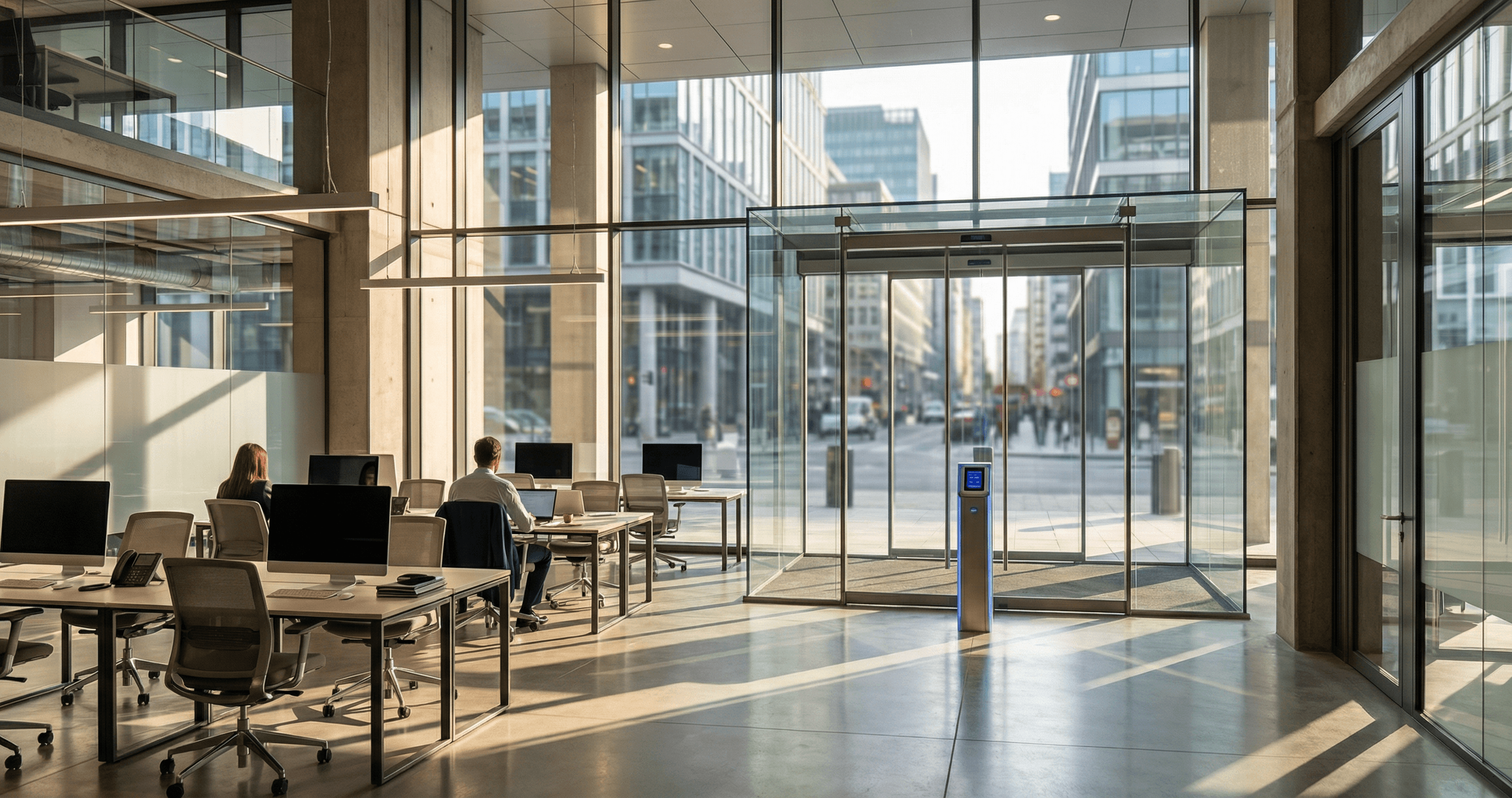
Your office building's security was designed for a simple world: everyone shows up Monday through Friday, 9 to 5. A receptionist greets visitors. Employees recognize each other. The building is either full or empty, and you plan accordingly.
That world is gone. According to Gallup, 52% of remote-capable workers now work hybrid schedules. CBRE research puts it more starkly: 92% of organizations globally have adopted some form of hybrid program. The result is office buildings that swing between 30% and 90% occupied in a single week, and security systems built for predictable attendance that now protect unpredictable spaces.
Most offices have adapted their collaboration tools, meeting rooms, and desk booking for hybrid work. Far fewer have updated their hybrid workplace security. Here are three gaps that creates, and what actually closes them.
The Occupancy Reality Behind Hybrid Workplace Security
Before getting into specific gaps, it helps to understand the pattern. Kastle Systems, which tracks access card swipes across thousands of U.S. office buildings, has documented a consistent weekly rhythm:
| Day | Typical Occupancy | Security Implication |
|---|---|---|
| Monday | 45-55% | Moderate: building waking up |
| Tuesday | 65-80% | Highest: peak visitor day |
| Wednesday | 65-80% | High: most in-person meetings |
| Thursday | 55-70% | Moderate: starting to thin out |
| Friday | 25-40% | Lowest: skeleton crew |
This pattern holds across industries and metro areas. The problem isn't low occupancy per se. It's the variability. A security model designed for consistent, high occupancy fails when Monday looks completely different from Wednesday, and Friday looks different from both.
Gap 1: Visitors Arrive When Nobody's at the Door
In a fully staffed office, someone is usually near the entrance. A receptionist, an office manager, or at minimum, a steady stream of employees coming and going who can check on someone standing in the lobby.
In a hybrid office, that coverage is unreliable. On a Tuesday with 80% attendance, the lobby is active and naturally monitored. On a Friday at 35% occupancy, a visitor might stand at the door for ten minutes before anyone notices. The consequences cascade from there. Visitors prop doors open. Delivery drivers leave packages in unsecured areas. People who shouldn't have access walk in behind someone who does.
This last problem, known as tailgating, is one of the oldest physical security risks in commercial buildings. Tailgating prevention is difficult under any circumstances, but hybrid work makes it significantly worse. When only a third of the office is in, the social pressure that normally stops tailgating ("I don't recognize you, who are you here to see?") vanishes. Everyone assumes the unfamiliar face belongs to someone else's team.
If your office already deals with visitors arriving to an unattended entrance, our guide to managing office visitors without full-time reception covers several practical approaches.
Gap 2: Non-Standard Schedules Break Traditional Access Windows
Hybrid work doesn't just change how many people show up. It changes when they show up. Some employees come in at 7 AM to avoid commute traffic. Others arrive after lunch and work until 8 PM. Some come in on weekends to use the office while it's quiet.
Traditional access control handles this poorly. Fixed access windows (say, 8 AM to 6 PM on weekdays) either lock out legitimate employees who work odd hours or stay open so wide they provide no real security boundary. The workaround most offices adopt is giving everyone 24/7 badge access, which defeats the purpose of access control entirely.
The problem extends to vendors and service providers. Cleaning crews, IT contractors, and maintenance workers need access at irregular hours. In a traditional office, someone is around to let them in and verify who they are. In a hybrid office on a Friday evening, that contractor is buzzing an empty building. Many end up with permanent access credentials that never get revoked, creating a growing pool of unmonitored access points.
After-hours building access is a challenge even for residential buildings. In offices with hybrid schedules, it becomes a daily occurrence rather than an edge case.
Gap 3: The Stranger Recognition Problem
Here's a security mechanism most people don't think about: in a traditional office, people recognize each other. When someone unfamiliar walks through the space, it registers. Not formally, not through any system, but through the simple human awareness that comes from seeing the same faces every day.
Hybrid work breaks this. When only 40% of the company is in on any given day, and the composition changes daily, almost everyone looks unfamiliar. The new hire on the marketing team? You've never seen them because you're never in on the same days. The contractor who's been coming weekly for three months? Nobody on your Tuesday-Thursday schedule has ever overlapped with their Monday visits.
This creates an environment where social engineering is significantly easier. Someone who walks in confidently, carrying a laptop bag and heading for the kitchen, reads as "probably works here" in a hybrid office. In a fully staffed traditional office, someone would eventually ask who they are. When half the desks are empty and the faces change daily, that instinct disappears.
The practical result: offices lose their most effective, lowest-cost security layer without even noticing.
Why Badge-and-Buzzer Systems Can't Keep Up
Most office security still runs on two technologies: badge readers at doors and a buzzer or intercom at the main entrance. These systems were designed with assumptions that hybrid work has invalidated:
Assumption 1: Someone answers the buzzer. In a hybrid office, the person assigned to answer the intercom might be working from home. Calls go unanswered, or get routed to someone who has no context about the expected visitor.
Assumption 2: Access schedules are predictable. Badge systems work well when access windows match work hours. They struggle when "work hours" vary by person and by day.
Assumption 3: The access log is meaningful. A badge swipe tells you someone entered. It doesn't tell you if they tailgated someone in, if a badge was shared, or if the person who entered was actually the badge holder.
Assumption 4: Low traffic means low risk. Many security systems reduce monitoring during off-peak hours, precisely when hybrid offices are most vulnerable. Friday afternoons with 30% occupancy get less attention than Tuesday mornings at 80%.
Even CISA's best practices for facility access control emphasize layered verification and consistent monitoring. Those principles don't change for hybrid offices, but the implementation must.
The Pew Research Center found that 75% of workers who can work remotely do so at least some of the time, and 46% say they'd likely leave their job if remote work was taken away. Stanford's WFH Research group has shown hybrid work reduces attrition by 33%. Hybrid isn't temporary. Security systems need to catch up.
What Smart Access Management Actually Looks Like
Closing these gaps doesn't require gutting your security infrastructure or hiring full-time guards. It requires shifting from passive, hardware-dependent systems to active, policy-based access management.
Policy-driven visitor verification. Instead of relying on whoever happens to be near the buzzer, AI-powered access systems can screen visitors through conversation before they enter. The system asks who they're visiting, checks against expected arrivals, and routes the call to the right person. No receptionist required, no unanswered buzzes. Solutions like Knockli handle this automatically, applying your office's visitor policies consistently whether it's a busy Tuesday or a quiet Friday.
Flexible access windows. Rather than one-size-fits-all building hours, smart systems can enforce different policies for different times and visitor types. Employees get broader access windows. Vendors get access only during their scheduled service times. Unknown visitors get screened regardless of when they arrive.
Complete audit trails. Every entry attempt gets logged with context: who buzzed, when, what they said, how it was handled, whether access was granted. This replaces the black box of a simple badge swipe log with actionable security data.
After-hours routing. When someone buzzes outside normal hours, the call doesn't go to an empty desk. It routes to the on-call person, a security service, or an AI system that can handle the interaction. The building is never truly unattended.
For offices evaluating their current setup, our breakdown of office security without a dedicated team covers how to build a security posture that doesn't depend on headcount.
Getting Started Without Overhauling Your Infrastructure
You don't need to replace your access hardware to address hybrid security gaps. Start with these steps:
1. Map your actual occupancy patterns. Track badge swipe data or simply observe for two weeks. Know your peak days, your low days, and your highest-risk windows (usually Friday afternoons and early mornings before the first wave arrives).
2. Identify your single biggest gap. For most hybrid offices, it's one of three things: visitors arriving to an unattended entrance, after-hours access for flexible-schedule employees, or vendor access with no one to let them in. Pick the most urgent problem first.
3. Evaluate software-first solutions. The fastest path to better security is software that works with your existing intercom or buzzer system. No hardware installation, no construction, no building management approval process. Knockli's AI-powered access management works with existing telephone entry systems and takes minutes to configure, not months to install.
4. Start with visitor management, then expand. Get visitor screening working first. Once that's solid, layer in after-hours policies, vendor access windows, and audit trail monitoring. Building security incrementally is more sustainable than trying to overhaul everything at once.
According to Owl Labs' 2025 State of Hybrid Work report, hybrid work continues to grow, and employees increasingly expect schedule flexibility. Your security posture needs to assume hybrid is permanent, not a phase you're waiting out.
Your building's access system was designed for a world where everyone showed up Monday through Friday. That world doesn't exist anymore. The offices that fix these gaps now won't just be more secure. They'll be better prepared for however work continues to evolve.
Ready to close the hybrid security gap? See how Knockli works for offices. AI-powered visitor screening, after-hours access routing, and complete audit trails, all working with your existing intercom system. Setup takes minutes, not months.
Related Articles
Office Visitor Management Without Full-Time Reception
Learn how offices handle visitors without front desk staff using AI-powered visitor management. Compare costs, features, and implementation strategies.
Small Office Security Without a Security Team: What Actually Works
How small offices prevent theft and unauthorized access without security staff. Real costs, audit trails, and 24/7 access control.
Startup Visitor Management Without the $53K Receptionist
How startups manage visitors, deliveries, and vendors without a receptionist. Compare costs, save $50K+ annually, and look professional.