Apartment Food Delivery That Actually Arrives Hot
Ordering food to your apartment building shouldn't mean meeting your driver on the sidewalk in pajamas. From delivery instructions that actually work to smart building access, here's how to make sure your apartment food delivery arrives the way you ordered it.
Knockli
AI Doorman
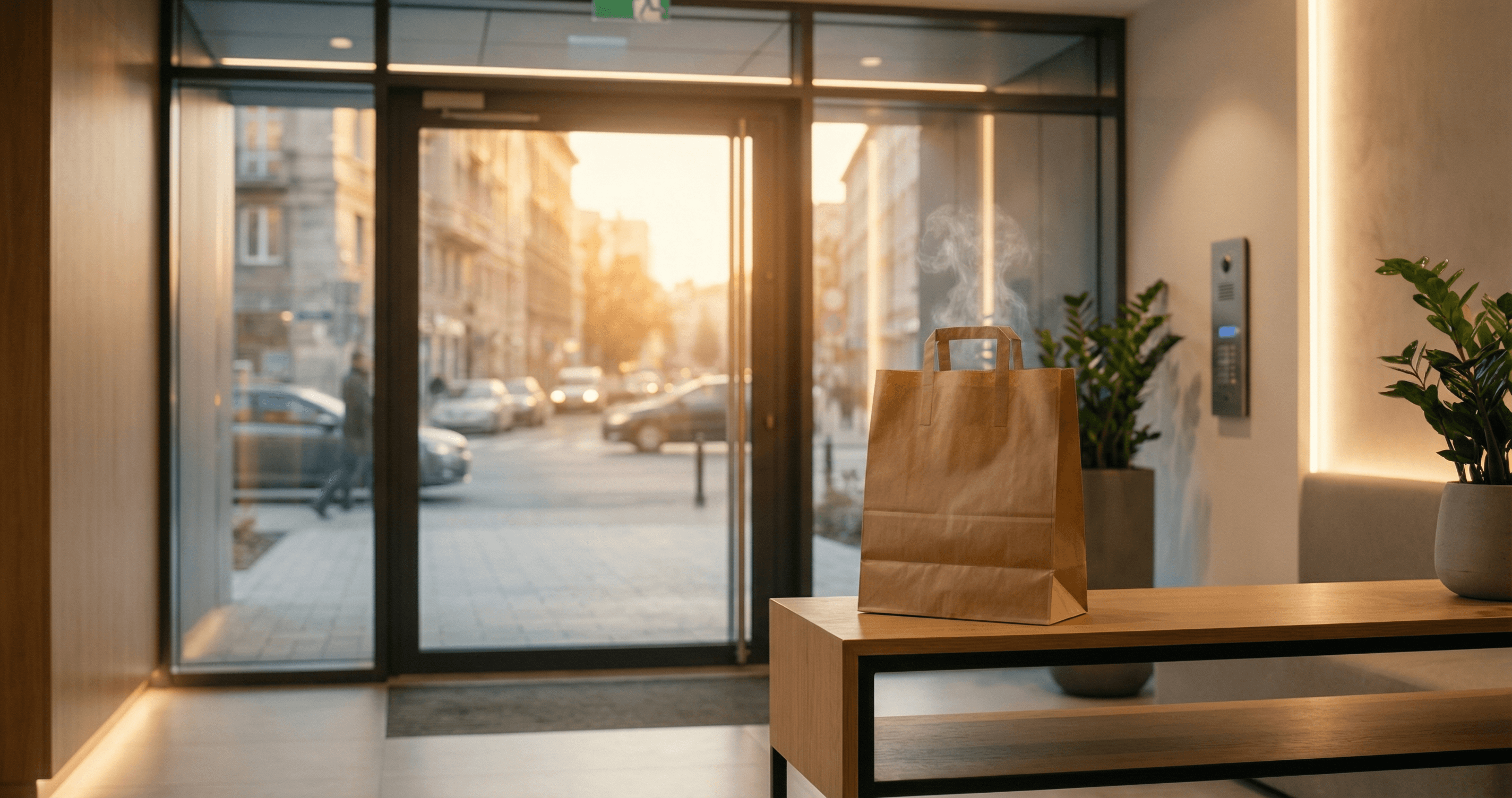
You tracked your order through every stage. Picked up. On the way. Two stops ahead. And then your delivery driver is circling the building, calling a number you can't hear, while your apartment food delivery cools off in a paper bag on the front seat of a Honda Civic.
This happens to apartment residents constantly. Unlike houses with front porches and visible addresses, apartment buildings put a locked door between your driver and your dinner. The result is food that arrives late, cold, or not at all.
The apartment food delivery problem isn't about slow restaurants or lazy drivers. It's a building access problem. And once you understand the real bottleneck, fixing it is surprisingly straightforward.
Why Apartment Food Delivery Is So Frustrating
Apartment food delivery is harder than house delivery because of one physical barrier: your building's front door. Drivers face locked entrances, confusing intercom systems, and limited ways to reach you. The result is food that arrives cold, orders marked "delivered" at the wrong door, and residents trudging downstairs in their pajamas to meet a driver on the sidewalk.
The numbers paint a clear picture. Per The Property Tribune, 37% of high-rise apartment residents collect food deliveries on the street because drivers can't access the building, and 40% report receiving cold or damaged food deliveries. Those aren't edge cases. That's nearly half of all apartment delivery orders going sideways.
The food delivery market has exploded. Statista estimates the global online food delivery market at $177.9 billion and growing. But the infrastructure in most apartment buildings hasn't kept up. Your building's buzzer was designed for guests who know which button to press, not for a DoorDash driver making their eighth stop of the hour.
As the New York Times reported, the post-pandemic delivery surge left many buildings scrambling to handle volumes of food and package deliveries they were never designed for. Lobbies aren't loading docks. Intercoms aren't customer service lines. And the mismatch shows up on your doorstep as lukewarm pad thai.
The Building Access Bottleneck
Most apartment food delivery failures trace back to one issue: the driver can't get through your building's front door. When access fails, drivers circle the building, call repeatedly, or press every buzzer in the lobby. Each wasted minute means your food gets colder.
How Minutes Turn Into Cold Food
Here's what typically happens when a driver gets stuck outside:
- Driver arrives and can't find your unit's buzzer (or the buzzer doesn't respond)
- Driver calls your phone, which is on silent or charging in another room
- Driver waits 3-5 minutes, food sitting in the car or on the ground
- Driver gives up or marks it "delivered" at the lobby entrance
That 3-5 minute delay matters more than you'd think. Hot food begins losing quality the moment it leaves the restaurant's heat lamps. By the time a driver navigates a confusing lobby, waits for an elevator, and reaches your floor, your order has been cooling for 10-15 minutes longer than necessary.
The Buzzer Bombing Problem
What is buzzer bombing? Buzzer bombing occurs when delivery drivers press every intercom button in an apartment building to gain entry, rather than buzzing the correct unit. It's a growing source of frustration for residents who receive constant false buzzes from drivers attempting to access other apartments.
If your intercom has ever rung at 9 PM from a driver delivering someone else's order, you've experienced buzzer bombing firsthand. It's a side effect of confusing intercom systems and time-pressured drivers who need to get inside quickly. Beyond being annoying, it creates a real security issue: someone inevitably buzzes the driver in without knowing who they are.
Whether buzzer bombing is disrupting your evenings or causing buzzer interruptions during your workday, the root cause is almost always a building access system that doesn't give drivers a clear, simple path to the right unit.
Delivery Instructions That Actually Work
The single most effective thing you can do for reliable food delivery is write clear, specific delivery instructions in your app. Include your building name, gate code, unit location, and a backup plan. Drivers see your notes for a few seconds at a time, so every word needs to count.
A Template That Works on Every Platform
Here's what to put in your delivery notes on DoorDash, Uber Eats, Instacart, or Grubhub:
Building name + access code + directions to unit:
"The Meridian Apts. Gate code 1234. Enter lobby, elevators on right. Unit 7B, 7th floor. If buzzer doesn't work, call me."
Keep it concise. Drivers are reading this on a small phone screen while juggling bags of food, so skip the backstory and lead with the access code.
Platform-Specific Tips
With millions of food delivery orders placed weekly in the U.S., platforms have improved how they surface delivery instructions to drivers. Each one handles notes a bit differently:
- DoorDash: Add permanent delivery instructions in your address settings, plus per-order notes for anything specific to that delivery
- Uber Eats: Use the "Add delivery note" field and drop a pin for your building's exact entrance
- Instacart: Notes go directly to your shopper, who is often more willing to follow detailed multi-step directions
- Grubhub: Delivery instructions are prominently displayed to drivers before they leave the restaurant
What NOT to Write
Avoid vague instructions that waste your driver's time (and cool your food):
- "I'm in the building on Main Street" (which building?)
- "Just come up" (how does the driver get in?)
- "Call when you're here" (adds 2-3 minutes of delay while your food sits)
If you're looking for more strategies to stop missing apartment deliveries, optimizing your instructions is the single highest-impact change you can make in under five minutes.
The Tipping Factor Most Residents Overlook
Tipping before delivery changes how your order gets treated. Tips make up approximately 51% of a food delivery driver's total income, and pre-tipped orders get accepted faster, prioritized in driver routing, and handled with more care. A few extra dollars can mean the difference between hot food and a lukewarm disappointment.
According to Business Insider's analysis of Gridwise data, tips represent the majority of what drivers earn. Base pay from delivery apps is often minimal, so your tip directly affects which driver picks up your order and how much effort they put into navigating your building.
How Tipping Affects Your Delivery
- Pre-tip generously: Drivers see your tip before accepting the order. A $2 tip on a $40 order signals "not worth the hassle." A $5-8 tip gets faster acceptance and more attentive handling.
- Tip more for complex buildings: If your apartment requires a gate code, an elevator, and a long hallway, compensate the driver for that extra time and effort.
- Don't use tips as leverage: Promising to "tip in cash" while showing $0 in the app means many experienced drivers will skip your order entirely.
It helps to think about this from the driver's perspective. They see a list of available orders, each showing estimated distance, building complexity, and total payout. An order going to a high-rise with no tip and vague instructions? That sits unclaimed. An order with a $7 pre-tip and clear directions for getting inside? That gets picked up immediately.
This isn't about generosity for its own sake. It's about understanding the incentive system that determines whether your food arrives hot or cold.
Building Access Solutions for Apartment Food Delivery
Building access solutions for food delivery range from simple lobby drop-offs to AI-powered intercom systems that verify drivers and grant access automatically. The right approach depends on your building type, how often you order, and whether you're willing to walk downstairs every time your food shows up.
Low-Tech Options
Lobby or vestibule drop-off: Set delivery instructions to "Leave at lobby door" or "Leave in vestibule." This works when drivers can reach a semi-secure area without a key. The downside: food sits unattended, and in busy buildings, order mix-ups happen more often than you'd expect.
Meet the driver downstairs: The most reliable low-tech option, but also the most inconvenient. You're heading downstairs in whatever you're wearing, and if the driver is running late, you're standing in a lobby refreshing your tracking app. That said, it guarantees a warm handoff.
Smart Access Options
Smart locks and keypads: Some buildings have keypad entries where you can share a temporary code with drivers. This works, but codes spread quickly and create a security risk when dozens of drivers have your building's access code.
AI-powered intercom systems: This is where technology catches up to the problem. Services like Knockli intercept your building's buzzer calls and use AI to screen visitors, including delivery drivers. When a DoorDash driver buzzes your unit, the AI can verify they're delivering food and grant access without you picking up the phone or leaving the couch. It works with your existing buzzer. No hardware changes. No landlord approval required.
Choosing the Right Approach
| Solution | Best For | Cost | Reliability |
|---|---|---|---|
| Lobby drop-off | Low-security buildings | Free | Medium |
| Meet driver | Any building | Free | High (inconvenient) |
| Temporary codes | Keypad buildings | Free | Medium |
| AI-powered intercom | Phone-based buzzer buildings | $15-30/mo | High |
For residents who order food delivery several times a week, automating building access pays for itself in convenience alone. No more sprinting downstairs. No more cold food. No more strangers buzzing your apartment because a driver hit every button in the lobby.
Keeping Your Food Safe After Delivery
Once food arrives, the safety clock is still running. The FDA recommends consuming delivered food within two hours of preparation, or within one hour if outdoor temperatures exceed 90 degrees Fahrenheit. Reheating does not eliminate all bacteria that multiply in the temperature danger zone between 40°F and 140°F.
The FDA's food delivery safety guidelines emphasize that food left in the danger zone (between 40°F and 140°F) for more than two hours should be discarded, even if it looks and smells fine.
Practical Steps When Your Order Arrives
- Eat hot food promptly: Don't let it sit on the counter while you finish an episode
- Refrigerate cold items immediately: Grocery deliveries from Instacart or similar services should go in the fridge right away
- Check temperatures when unsure: A food thermometer is a $10 investment that eliminates guesswork
- Reheat thoroughly when needed: FoodSafety.gov recommends reheating leftovers to an internal temperature of 165°F
This matters even more when building access delays add five or ten minutes to your food's journey. In summer heat, that extra time can push a marginal delivery past the safe window entirely. Every strategy in this article, from better delivery instructions to smarter building access, ultimately serves the same goal: shrinking the gap between "food leaves restaurant" and "food reaches your plate." The shorter that window, the better your food tastes and the safer it is to eat.
Tired of food going cold while the driver circles your building? Knockli's AI doorman answers your buzzer, verifies delivery drivers, and grants access automatically so your food arrives hot and your evening stays uninterrupted. Setup takes 10 minutes with your existing intercom. No hardware. No landlord approval.
Related Articles
Apartment Delivery Problems Aren't the Driver's Fault
8-20% of apartment deliveries fail because your building wasn't designed for packages. Data analysis of the $17.78-per-failure cost.
Introducing Knockli: Your AI Doorman Is Here
Knockli is your AI doorman. It answers your apartment buzzer, screens visitors, and handles deliveries automatically. No hardware needed, no landlord approval.
What Is an AI Doorman? (And Should You Get One?)
An AI doorman answers your apartment buzzer, screens visitors, and unlocks the door by your rules. How it works, costs, and fit.