Last-Mile Delivery's $95 Billion Problem Routing Can't Solve
Delivery times halved since 2020, yet 8-20% of packages still fail on first attempt. The logistics industry spent billions perfecting vehicle routes while the real hemorrhage - up to $95 billion annually - happens the moment a driver steps out of the van and faces a locked vestibule.
Knockli Team
Building Access Intelligence
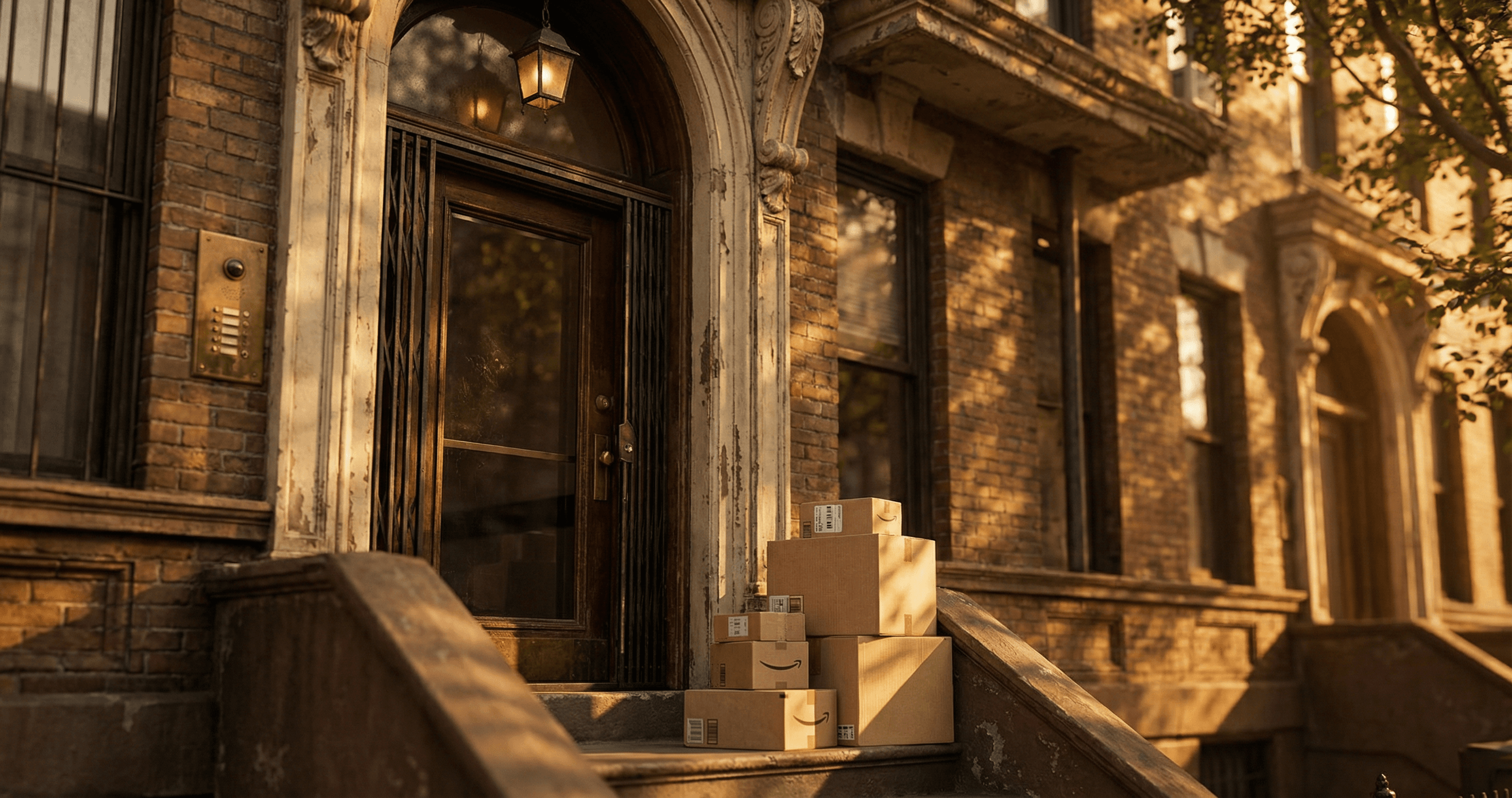
U.S. e-commerce delivery times dropped 43% between 2020 and 2025, falling from 6.5 days to just 2.47 days on average. Carriers invested billions in algorithmic routing, regional fulfillment centers, and fleet optimization. By any macro measure, the supply chain has never been faster.
And yet, last-mile delivery failure rates have barely budged. Between 8% and 20% of packages still fail on their first attempt. In dense urban cores, that number climbs to 25%. The industry's most expensive problem isn't happening on the highway or in the sorting facility. It's happening in the last 50 feet between the delivery van and a locked apartment door.
This is the paradox at the center of American logistics: the macro supply chain has been optimized to near-perfection, while the micro handoff at the destination remains stubbornly, expensively broken.
Last-Mile Delivery Costs: Where the Money Actually Bleeds
Last-mile operations now account for 53% of total shipping costs, a steep escalation from 41% just six years ago. In an era when U.S. business logistics costs have surged to $2.6 trillion (nearly 9% of GDP), that concentration of cost in the final leg represents a structural threat to retail profitability.
When a delivery fails, the financial damage compounds rapidly. The direct cost of a single failed delivery averages $17.78 across the industry. That figure erodes, and often completely eliminates, the profit margin on a standard e-commerce order. Aggregated nationally, delivery failures, replacements, and the customer churn they trigger contribute to an estimated $216 billion in lost retail revenue annually.
The $17.78 average isn't a flat penalty. It's a composite of cascading costs:
- Re-delivery labor. In the B2C sector, re-deliveries consume 1% to 3% of total carrier revenue, with roughly 10% of last-mile packages requiring at least a second attempt. Labor accounts for 50% to 60% of last-mile expenses. Forcing highly compensated drivers to duplicate routes destroys yield.
- Dwell time. Extended time at the curb while drivers struggle to gain building access devours an estimated 160 million labor hours annually in the U.S. B2C sector alone. Every minute a driver spends outside a locked vestibule is a minute the vehicle sits idle, burning fuel and delaying subsequent stops.
- Customer defection. 23% of consumers refuse to reorder from a retailer after a single failed delivery. An overwhelming 84% will abandon a brand entirely after a severely negative delivery experience. 41% blame the retailer, not the carrier.
The leading cause of these failures? Address ambiguity. Not wrong street numbers, but missing apartment identifiers, incorrect access codes, poorly marked rear entrances, and buildings that simply cannot be entered without a resident present. Address-related errors account for 45% of all failed deliveries.
The Architecture Nobody's Optimizing For
The fundamental collision is between contemporary e-commerce volume and historical residential architecture. U.S. carriers delivered 3.1 billion packages in 2010. By 2024, that volume had surged past 22 billion parcels annually. Cities whose spatial geometries were designed for pedestrians and streetcars now absorb a daily deluge of delivery vans.
Nowhere is this friction more severe than in neighborhoods dominated by pre-1940 housing. Walk-up apartments, historic brownstones, and early 20th-century multi-tenant buildings lack the physical infrastructure to absorb modern delivery volume: no elevators, no staffed lobbies, no secure mailrooms, no parcel lockers.
The USPS Office of Inspector General documented this problem through ride-along audits in cities like New York. A carrier could easily spend up to 10 minutes completing a single delivery inside one dense apartment building. The driver must find curb parking on streets never designed for commercial trucks (up to 80% of urban deliveries involve illegal parking), gain entry through an analog buzzer that may or may not work, and then physically carry packages up multiple flights of stairs. The National Apartment Association reports that 53% of property managers still rely exclusively on mechanical keys for building access.
The result: old-stock urban areas are consistently where carrier profit margins are at their absolute lowest.
City-level evidence
The scale of this problem varies by city, but the pattern is consistent across every major metro with significant pre-war housing stock.
| Metro | Key Logistics Challenge | Pre-1940 Housing | Annual Theft Loss (2024) |
|---|---|---|---|
| New York City | 2.5M daily parcels, severe congestion, minimal loading zones | ~30%+ | $945 million |
| Chicago | Highest per-household theft rate (728/1,000 homes) | 40.4% | $262 million |
| Philadelphia | Zero-setback rowhouses, single-lane streets, high visibility theft | 41.2% | $450 million |
| San Francisco | Extreme topography, time-restricted zones, near-zero new construction | High | Data unavailable |
New York City processes 2.5 million package deliveries every day, up from 1.1 million in 2017. To support this volume, 18 last-mile distribution facilities opened within city limits since 2017, with 68% concentrated in Environmental Justice areas. Truck-related crashes near these facilities increased 146%. Injury rates at last-mile facilities run more than triple the national average (8.3 vs. 2.4 per 100 employees). Drivers in Manhattan, Brooklyn, and Queens lose 117 hours annually to traffic congestion, increasingly switching from vans to handcarts and cargo bikes.
Chicago leads the nation in per-household package theft at 728 thefts per 1,000 homes. FOIA data shows the city recorded 9,703 reports of lost or missing mail between 2022 and 2024, the highest count in the United States. When the city piloted delivery robots to bypass congestion, 84% of residents in the Lakeview East neighborhood opposed expansion, citing sidewalk clutter and ADA violations.
Philadelphia's tightly packed rowhouses front directly onto narrow one-way streets with virtually zero buffer zone between the sidewalk and the front door. Packages left at these doors are visible and accessible from the public sidewalk. This architectural vulnerability contributes to Philadelphia ranking as the second-worst metro for package theft in the nation, with $450 million in stolen goods in 2024.
For property managers dealing with the downstream effects of these delivery failures, building-level package theft prevention strategies can address the access gap that makes multifamily properties especially vulnerable.
Last-Mile Delivery Optimization: The $95 Billion Routing Illusion
Here is the contrarian reality the logistics industry has been slow to confront: street-level vehicle routing is a largely solved problem. The true operational hemorrhage occurs entirely within the "Final 50 Feet."
The vast majority of venture capital, academic research, and corporate investment in last-mile delivery optimization focuses on the Vehicle Routing Problem. Companies pour billions into AI-driven dynamic routing, predictive traffic modeling, and geospatial load balancing to ensure a van takes the mathematically optimal path from fulfillment center to GPS coordinate.
But advanced algorithms cannot unlock a physical vestibule door, coax a broken analog intercom into functioning, or force an absent resident to answer their buzzer. Operational research confirms that the majority of time consumed during urban parcel delivery is not spent driving on streets but moving through the physical floors of a building, searching for recipients, or processing the paperwork for a failed attempt.
McKinsey analysts describe this as the "blind handoff". Supply chain visibility is near-perfect while a package crosses the country. Consumers can literally watch the van move on a map. But that visibility drops to zero the moment the driver steps onto the sidewalk. McKinsey estimates these blind handoffs generate between $65 billion and $95 billion in pure economic waste annually within the U.S. logistics economy. Interactions characterized by communication gaps, physical barriers, and reliance on manual engagement account for 13% to 19% of total logistics costs.
Shaving two minutes off a transit route through machine learning produces no net benefit if the driver then spends ten minutes climbing stairs, searching for an apartment, or reloading an undeliverable package into the truck. The industry's relentless obsession with macro-routing ignores the micro-barriers of old-stock architecture.
What the Data Says Actually Works
If the bottleneck is building access rather than vehicle routing, then the highest-return interventions are physical, architectural, and infrastructural, not algorithmic.
Parcel lockers: powerful but paradoxical
The Urban Freight Lab's landmark pilot at the 62-story Seattle Municipal Tower provides the clearest empirical evidence. Before a common-carrier locker was installed in the lobby, couriers spent an average of 27 minutes performing floor-to-floor deliveries. After installation, total delivery time dropped to 5.6 minutes, a 78% reduction, with a failed delivery rate of zero.
The economics are compelling. Smart lockers save an estimated $3 to $5 per parcel in direct re-delivery costs, effectively erasing the $17.78 failure penalty. The USPS calculates that a $1,000 locker investment can pay for itself in 2.4 years through reduced carrier labor costs alone.
But a deeper finding complicates the narrative. A difference-in-difference analysis of a residential locker deployment in Seattle found that while in-building time dropped significantly, curbside vehicle dwell time showed only a small, statistically insignificant reduction. The driver still needs to park, locate packages in the cargo bay, scan them out, and load a handcart. Lockers rescue carrier profit margins but don't automatically solve municipal congestion.
The U.S. locker market is also severely fragmented. Unlike Europe, where common-carrier lockers are integrated into transit hubs and accessible to any logistics provider, the American market is dominated by proprietary, single-carrier systems (Amazon Hub, UPS Access Point, FedEx OnSite). A resident's nearby Amazon locker is useless for a USPS or regional 3PL delivery. True open-network lockers remain scarce relative to urban parcel volume.
For buildings where locker hardware isn't practical, intercom-based delivery verification offers an alternative path that works with existing infrastructure.
Digital access control in old-stock buildings
Where lockers can't be installed due to spatial constraints or historic preservation rules, property managers are bridging the gap with digital access control. The goal: convert the physical barrier of a locked pre-war vestibule into a digital handshake.
Cloud-based smart intercom systems route buzzer calls to a tenant's smartphone regardless of whether they're home. The tenant verifies the courier via video and remotely unlocks the lobby door. More advanced systems generate single-use, time-restricted delivery PINs that carriers can input directly, bypassing the locked door and leaving the package in a secure hallway rather than on an exposed stoop.
Knockli takes this further by replacing the manual tenant response entirely. AI answers the intercom call, verifies the carrier through natural conversation, and applies the building's delivery policies automatically. Verified carriers gain access during permitted hours. Unverified callers are screened or declined. Every interaction is logged. The building's front door stops being the point where supply chain visibility drops to zero and starts being a managed access point with policy enforcement and audit trails.
This intervention doesn't eliminate the driver's labor of walking the package upstairs. But it dramatically reduces first-attempt failure rates and directly addresses the $15.93 billion porch piracy epidemic. 120.5 million packages were stolen in the U.S. in 2024 according to SafeWise's metro analysis. The architectural vulnerability of old-stock buildings, where front doors sit inches from public sidewalks, makes digital access control a high-leverage countermeasure.
Micro-freight: when vans can't get through
The brute-force approach of running more diesel step-vans into congested urban streets has reached diminishing returns. Carriers in pedestrian-heavy and time-restricted zones are shifting to electric cargo bikes and on-foot dispatch models. A cargo bike uses protected bike lanes to bypass vehicular gridlock, parks easily, and emits nothing. While it can't match a box truck's volume, its velocity and maneuverability in dense cores make it economically viable for the final mile.
The World Economic Forum estimates that under business-as-usual, carbon emissions from urban delivery traffic could increase 32% to 60% by 2030. Widespread adoption of lockers and alternative delivery modes could reduce delivery costs by 2% to 12% and emissions by 5% to 18%.
Meanwhile, the buildings themselves are getting smaller. NAIOP research shows that 4.1 million multifamily units delivered between 2015 and 2024 are 30 to 75 square feet smaller than older units. Less personal storage space means higher dependence on frequent, small-parcel e-commerce deliveries, placing even more strain on building access infrastructure.
The Front Door Is the Intervention Point
The data is unambiguous. Last-mile delivery failure in the United States is not a routing problem. It is a building access problem. The injection of 2.5 million daily packages into a city like New York, or the navigation of zero-setback rowhouse streets in Philadelphia, creates unavoidable friction when it collides with pre-1940 architectural constraints.
The logistics industry has spent decades perfecting vehicle movement through streets. The actual capital hemorrhage, up to $95 billion in blind handoff waste, occurs the moment the driver stops the vehicle and attempts to interact with the built environment.
True optimization requires shifting investment from the "last mile" to the "Final 50 Feet." Open-network parcel lockers, digital smart access controls in old-stock buildings, and micro-freight modalities are the interventions that bend the curve on 8-20% first-attempt failure rates, $216 billion in retail losses, and a $15.93 billion porch piracy epidemic.
Until the physical barrier of the front door is bridged, the theoretical perfection of the routing algorithm will keep failing at the threshold.
Knockli bridges the Final 50 Feet gap by turning your building's existing intercom into a managed, policy-driven access point. AI verifies delivery drivers, applies your rules, and logs every event. No hardware. No staff. See how it works for property managers.
Related Articles
Multifamily Package Management Without the Locker Investment
Parcel lockers cost $6,000-$21,000+ per installation. Learn how multifamily operators manage package delivery with intercom-based AI instead of locker hardware.
Smart Buzzer for Rentals: Automate Every Building Entrance
A smart buzzer for rentals automates visitor screening, delivery access, and entry policies with no hardware changes. Full guide for property managers.
Building Access Upgrades Driven by Lockouts, Not Break-Ins
NAA/KeyTrak research shows zero property managers cited security as a reason for smart access adoption. Lockouts, rekeying, and standardization drive upgrades.