Multifamily Package Management Without the Locker Investment
Parcel lockers cost up to $21,000 per installation, take months to deploy, and still can't handle oversized deliveries. Multifamily operators are turning to intercom-based AI verification to manage package delivery without the hardware investment.
Knockli Team
Building Access Intelligence
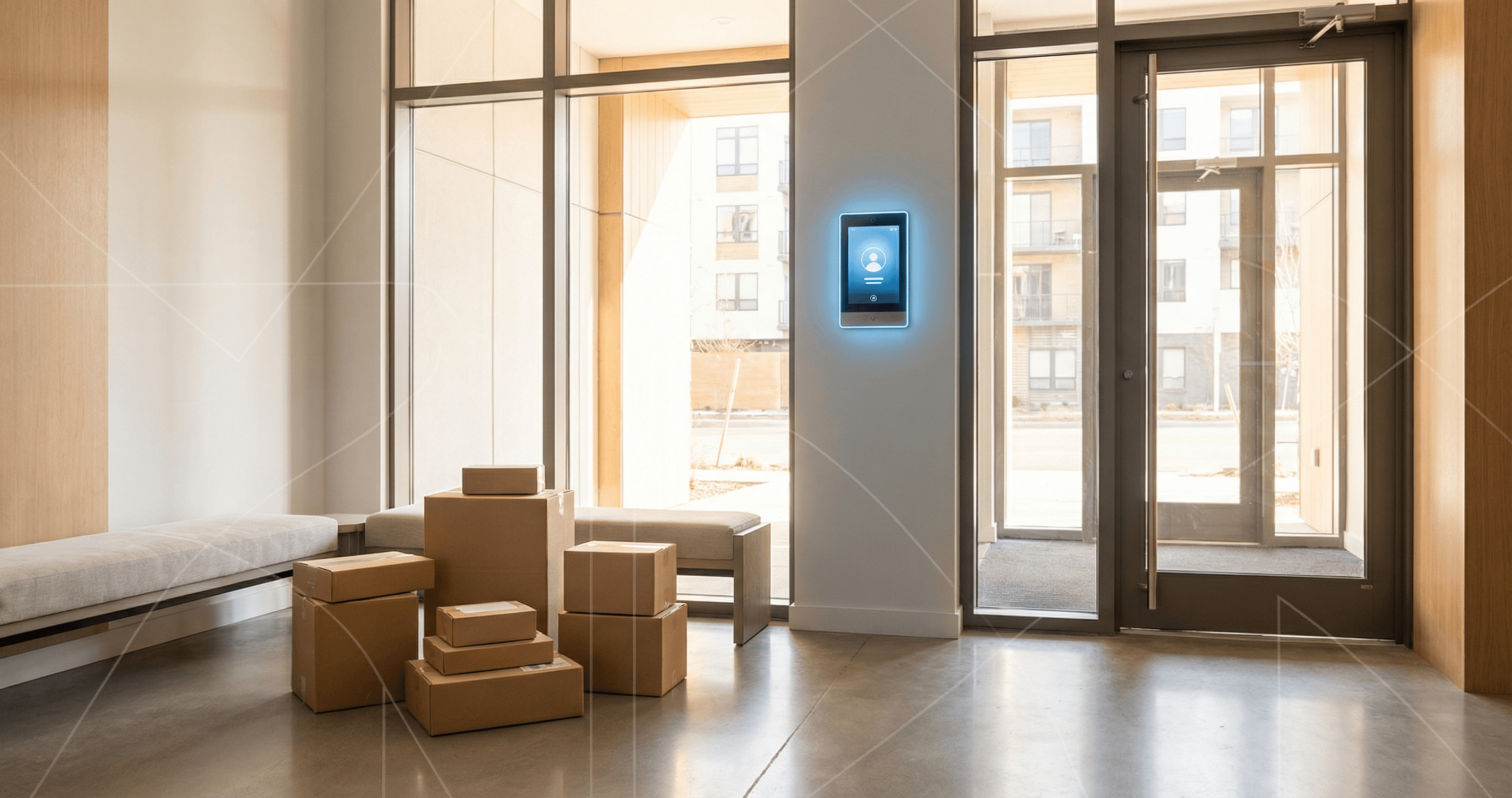
Multifamily package management has become one of the most expensive operational challenges in apartment buildings. US parcels reached 22.37 billion in 2024 according to the Pitney Bowes Parcel Shipping Index, and over 90% of apartment residents with delivery access receive at least one package per week according to Parcel Pending's 2025 Resident Preferences Report. The default response for many operators has been parcel lockers. But with hardware costs starting at $6,000 and climbing past $21,000 for larger systems, the locker approach carries a price tag that doesn't match every building's budget, timeline, or physical layout.
There is another path. Intercom-based delivery verification uses software to handle building package delivery operations without requiring hardware installation, construction, or capital expenditure. Here's how the approach works, when it makes more sense than lockers, and what results property managers can expect.
The Multifamily Package Management Challenge, by the Numbers
The volume of packages arriving at apartment buildings has grown faster than the systems designed to handle them. Understanding the current scale is essential for choosing the right management approach, because solutions that worked at lower volumes often break down under today's delivery load.
The U.S. Census Bureau reported e-commerce sales of $310.3 billion in Q3 2025, representing 16.4% of total retail. That spending translates directly into parcels arriving at apartment lobbies, mailrooms, and front doors every day. Pitney Bowes projects US parcel volume will reach 30 billion annually by 2030, meaning the pressure on multifamily buildings will only intensify over the next several years.
For a 200-unit building where residents average multiple packages per week, that translates to thousands of deliveries per month flowing through common areas. Each delivery is an access event: someone needs to enter the building, leave a package, and exit. Multiply that across a portfolio of five or ten properties, and the operational load becomes substantial.
The downstream effects are well-documented. Apartment residents are 3x more likely to experience package theft than single-family homeowners according to Security.org. Delivery-related complaints consistently rank among the top resident grievances in satisfaction surveys. Staff spend hours fielding buzzer calls, managing theft reports, and coordinating with carriers who can't get into the building.
For a deeper look at how package theft affects buildings and what prevention strategies work at the property level, see our guide to building-level package theft solutions.
The question for most property managers isn't whether to address package management. It's how to address it without overcommitting capital on a solution that may not fit every property in a portfolio.
Why Parcel Lockers Aren't the Full Answer
Parcel lockers solve the storage piece of the package problem, but they come with substantial costs, space requirements, and capacity limitations that make them impractical for many buildings. Property managers evaluating the full picture increasingly recognize that locker hardware is one viable option among several, not the only path forward.
According to Pitney Bowes' cost analysis, parcel locker systems range from $6,000 to $21,000+ per installation. That figure covers hardware alone. Add monthly software fees, maintenance contracts, and the cost of dedicating lobby or package room square footage to locker banks, and the total investment climbs further. ButterflyMX's research on package delivery costs highlights additional hidden expenses including staff labor for overflow management and the opportunity cost of repurposed common areas.
Beyond cost, lockers have structural limitations:
- Capacity ceilings. A 50-compartment locker serves a 200-unit building poorly when residents average 9+ packages per month. Oversized items like furniture, bulk household orders, and oddly shaped deliveries don't fit at all.
- Retrieval bottlenecks. Lockers only work if residents pick up packages promptly. Unclaimed packages create backlogs that cascade into missed deliveries, frustrated carriers, and packages left in lobbies anyway.
- Installation timelines. Hardware procurement, building permits, electrical work, and network setup can stretch deployment to 3-6 months per property. For portfolio operators, that means a full year or more to roll out across all buildings.
Buildings.com reported that MDU property managers are increasingly looking beyond lockers in favor of more flexible approaches to package management. The pattern is clear: lockers work well for certain buildings, but they are not a universal solution.
Parcel locker alternatives compared
The table below compares three approaches to managing apartment deliveries at the building level. Each addresses a different piece of the problem.
| Factor | Parcel Lockers | Package Room | Intercom-Based AI Verification |
|---|---|---|---|
| Upfront cost | $6,000-$21,000+ | $2,000-$5,000 (access hardware) | $0 hardware |
| Monthly cost | $200-$500 software fees | Minimal | Software subscription |
| Setup time | 3-6 months | 2-4 weeks | Under 15 minutes |
| Capacity | Fixed compartments | Limited by room size | Unlimited (no storage component) |
| Oversized packages | Cannot accommodate | Accommodates easily | Accommodates (lobby or door delivery) |
| Staff involvement | Overflow management | Monitoring required | Minimal |
| Portfolio scalability | Buy more units per building | Requires space per building | Add buildings instantly |
The right approach depends on building size, budget, and operational priorities. For operators who need coverage now without capital expenditure, software-based verification offers a faster path to results.
Intercom Delivery Management: How AI Verification Works
Intercom-based delivery verification uses AI to answer buzzer calls, identify delivery drivers through natural conversation, and grant or deny building access based on your policies. It works with existing phone-based intercom systems, requires no hardware changes to the building, and can be fully operational within minutes of setup.
Knockli is built on this approach. When a delivery driver buzzes a building entry, Knockli's AI answers the intercom call instantly. Through natural conversation, it determines who is calling and why. The system recognizes major carriers, including Amazon, FedEx, UPS, USPS, and DoorDash, by conversational context and applies your building's delivery rules in real time.
Here's the delivery verification flow:
- Driver buzzes the building. The call box dials the number assigned to that building entry or unit.
- AI screens the caller. The system identifies who they are and what they're delivering. Carrier recognition happens conversationally, not through IVR menus or PIN code lookups.
- Building policies apply automatically. Is it within your delivery window? Is this a recognized carrier? Does the unit accept auto-delivery? The system checks every rule you've configured.
- Access granted via DTMF unlock. Verified deliveries receive lobby access through the standard DTMF tone that triggers the door release. Unverified callers are politely declined or routed for additional screening.
- Everything is logged. Every call, every decision, and every outcome is recorded in the activity log with timestamps and caller details.
This process replaces the weakest link in most buildings' delivery operations: the resident who buzzes everyone in because screening each call is inconvenient. The AI applies your policies consistently whether it's 7 AM or 11 PM, on a Tuesday or a holiday weekend.
For buildings exploring how to modernize building access without hardware, intercom-based AI verification represents the lowest-friction path available. There's no construction, no permits, and no waiting for equipment to ship. You forward your call box line and configure your rules.
Knockli's property management solution supports single buildings and multi-building portfolios from one dashboard, making it practical to pilot on one property and measure results before rolling out across a portfolio.
Delivery Policies for Multifamily Package Management at Scale
Effective multifamily package management requires policies that are specific enough to protect residents and flexible enough to adapt across buildings with different needs. The key is configuring rules once and letting automation enforce them consistently, without relying on staff to remember and apply every policy manually.
Knockli uses natural language rules, which means you configure delivery policies in plain English rather than navigating complex settings menus. Examples of rules property managers commonly set:
- "Let verified carriers in between 8 AM and 7 PM on weekdays"
- "Require resident confirmation for all deliveries after 8 PM"
- "Decline all building access between midnight and 6 AM unless pre-authorized"
- "Allow DoorDash and UberEats during dinner hours and notify the resident"
These rules apply building-wide while still allowing unit-level customization. A resident who works nights can adjust their unit to hold all deliveries until afternoon. A resident expecting a large furniture delivery can pre-authorize a specific carrier for a specific day. Building defaults handle the majority of delivery events; individual exceptions handle the rest.
How does carrier verification work without access codes?
Traditional delivery management relies on maintaining carrier lists, distributing building access codes, and updating credentials when codes get compromised or shared too widely. Knockli's AI identifies carriers through conversational context rather than static code lists. A driver who says "FedEx, I have packages for the building" gets verified through the same natural language processing that handles all visitor screening.
This eliminates the maintenance burden of rotating access codes across properties. When a carrier changes drivers or delivery routes, the system still works because verification is conversational, not credential-based.
After-hours and weekend delivery policies
Package delivery doesn't follow business hours. Food delivery services, Amazon evening routes, and weekend shipments all generate buzzer calls outside the typical workday. Rather than choosing between unrestricted access and no access at all, Knockli lets you set graduated policies that match your building's risk tolerance:
- Business hours: Auto-unlock for verified carriers
- Evenings: Auto-unlock for verified carriers with resident notification
- Late night: Decline delivery access and suggest returning during business hours
For property managers looking to automate routine building operations without adding staff, delivery policy automation is often the highest-impact starting point. It addresses the most frequent access events in most buildings while freeing staff to focus on leasing, maintenance, and resident relations.
Measuring Apartment Delivery Verification Results
Tracking delivery management outcomes requires baseline metrics before implementation and consistent measurement afterward. The most useful indicators combine quantitative data from your access system with qualitative feedback from residents and on-site staff.
Delivery complaint volume
The clearest success signal is a reduction in delivery-related resident complaints. Track complaint volume before deploying any new system, then measure monthly. A meaningful drop within the first 60-90 days indicates the approach is working. Knockli's activity log provides the raw data: how many delivery calls were handled, how many were approved, how many were declined, and how many were escalated to staff or residents.
Staff time recaptured
The NMHC package delivery fact sheet documents the operational burden that rising package volume places on property management teams. Every buzzer call that staff handle manually is time pulled from leasing tours, maintenance coordination, and resident relations.
Calculate your baseline: how many minutes per day does your team spend managing delivery-related buzzer calls, fielding complaints, and coordinating with carriers? Even 30 minutes per day across a portfolio adds up to over 10 hours per month of staff time redirected to package logistics instead of higher-value work.
Theft incident correlation
With verified carrier access and logged entry events, buildings can cross-reference theft reports against the delivery record. If a resident reports a missing package, the activity log shows whether a verified delivery event occurred at that address and time, or whether the entry was potentially unauthorized. This data transforms theft investigations from guesswork into evidence-based analysis, and it strengthens your position in disputes.
Resident satisfaction and renewal rates
Package management quality directly influences renewal decisions, particularly in competitive rental markets where residents can easily find buildings that take delivery management seriously. For guidance on connecting access management improvements to resident satisfaction metrics, see our article on reducing delivery-related resident complaints. The buildings that solve the package problem often see satisfaction improvements that extend well beyond delivery management alone.
Moving Forward Without the Hardware Commitment
For property managers evaluating their options, the decision framework is straightforward:
- High volume, high budget, long timeline: Parcel lockers remain a strong choice for buildings that can absorb the $6,000-$21,000+ investment and wait 3-6 months for installation.
- Immediate coverage, no CapEx, policy flexibility: Intercom-based AI verification handles delivery operations through existing infrastructure, with setup measured in minutes rather than months.
- Hybrid approach: Some buildings combine a modest package room with AI-verified carrier access at the front door. The AI handles access control; the room handles temporary storage.
The package volume problem isn't going away. With 30 billion parcels projected annually by 2030, buildings that wait for the perfect hardware solution risk spending years managing deliveries manually while volume continues to climb. A software-first approach lets you start today, measure results immediately, and add hardware later if a specific building's needs justify the investment.
Knockli handles delivery verification, applies your building's package policies, and logs every access event automatically. No hardware installation required, and setup takes 10-15 minutes per building. See how Knockli works for property managers.
Related Articles
Last-Mile Delivery's $95 Billion Problem Routing Can't Solve
The logistics industry optimized routing while $95B in waste accumulates at building doors. Why old-stock housing drives delivery failure.
Apartment Package Theft Costs $15B: Building-Level Solutions
250,000 packages stolen daily in the U.S. - apartments are 3x more vulnerable. Building-level prevention strategies for property managers.
AI Doorman for Property Managers: What It Is and Why It Works
An AI doorman handles building access 24/7 without staff. Learn how it works, what it costs, and why property managers are adopting it.